Airscan’s flagship system-level assessment of indoor air quality, ventilation performance, and environmental stability designed to identify hidden risks, operational constraints, and performance limits in occupied buildings.
Indoor air quality isn’t a static condition that can be confirmed once and assumed thereafter. It fluctuates with occupancy, activity, ventilation behaviour, building operation – constantly. Often in ways that aren’t apparent until performance begins to decline. Airscan’s IAQ Performance Audit is built to account for this variability, identifying discrepancies between ventilation behaviour, pollutant presence, and environmental conditions across the operating cycle of a building.






Our IAQ Performance Audit is delivered as a structured, on-site assessment designed to surface hidden constraints, validate actual ventilation behaviour, and establish a defensible indoor air quality performance baseline under real operating conditions.
Measurement of actual air exchange effectiveness, airflow distribution using indicators such as temperature, humidity and CO2.
Assessment of PM₁, PM₂.₅, and PM₁₀ concentrations to identify exposure levels, persistence, and likely sources.
Evaluation of volatile organic compounds (VOCs) to assess ventilation adequacy and indoor emission load.
Targeted sampling and lab analysis to confirm biological risk where moisture, material, or environmental indicators warrant deeper investigation.
Indoor results interpreted against outdoor reference measurements to distinguish internal issues from ambient conditions.
Mapping occupancy patterns and pollutatnt exposure time to analyze the risk of health and productivity issues.
Indoor air quality performance is determined by a small number of interacting environmental conditions. Airscan’s IAQ Performance Audit defines its scope around parameters that most directly govern ventilation, pollutant behaviour, and exposure under real operating conditions.
Airscan’s IAQ Performance Audit is an indoor air quality assessment built around a defined set of environmental parameters that together form a complete indoor air quality performance profile.
| Catégorie de paramètres | Paramètres |
|---|---|
| Ventilation performance | Air exchange effectiveness, airflow distribution, pressure balance between zones |
| Particules | PM₁, PM₂.₅, PM₁₀ (concentration, persistence, spatial variation) |
| Chemical indicators | Carbon dioxide (CO₂), total volatile organic compounds (TVOCs) |
| Biological risk indicators | Targeted biological sampling and laboratory analysis where moisture, material, or environmental indicators warrant investigation |
| Comfort parameters | Temperature, CO2 and relative humidity (interpreted as supporting factors influencing pollutant behaviour and exposure) |
| Environmental baseline | Outdoor reference measurements used to contextualise indoor conditions |
Airscan’s IAQ assessors are trained and certified to deliver indoor air quality assessments with multiple occupational, building, and environmental frameworks across Europe and Asia.
| Framework category | Standards and regimes |
|---|---|
| Occupational IAQ regulation (Malaysia) | Industry Code of Practice on Indoor Air Quality (ICOP), Department of Occupational Safety and Health (DOSH) assessment and enforcement frameworks |
| Workplace health & safety (Malaysia) | DOSH-aligned industrial hygiene methodologies, employer duty-of-care and investigation requirements |
| European indoor environment standards | EU indoor environment and ventilation performance standards applied for building assessment and interpretation |
| Environmental air quality references | European and international air quality exposure guidance used for contextual benchmarking |
| International technical standards | ASHRAE indoor air quality and ventilation standards, relevant US EPA guidance where applicable |
| Building certifications and ESG frameworks | Assessment methodologies aligned with WELL, LEED, RESET, and comparable performance-based certification systems |
Airscan characterizes indoor air quality as it operates in real use – not to create artificial test conditions or make absolute claims. By doing so, results enable decisions that improve productivity, operational efficiency, and long-term cost control – connecting environmental performance directly to outcomes that matter strategically to the business.
Measurements are taken under representative occupancy, activity levels, and system operation wherever possible. This anchors findings in conditions that influence people and processes every day.
Results are interpreted across operating cycles, accounting for fluctuations linked to occupant density, ventilation response, and space usage.
Assessment depth scales with observed conditions, applying deeper investigation only where signals indicate meaningful exposure or inefficiency.
Findings are structured to support operational and financial decisions, linking environmental performance to workforce effectiveness, system reliability, and cost exposure.
The value of reliable indoor air quality assessments depend on the reliability of its data and independence of its interpretation.
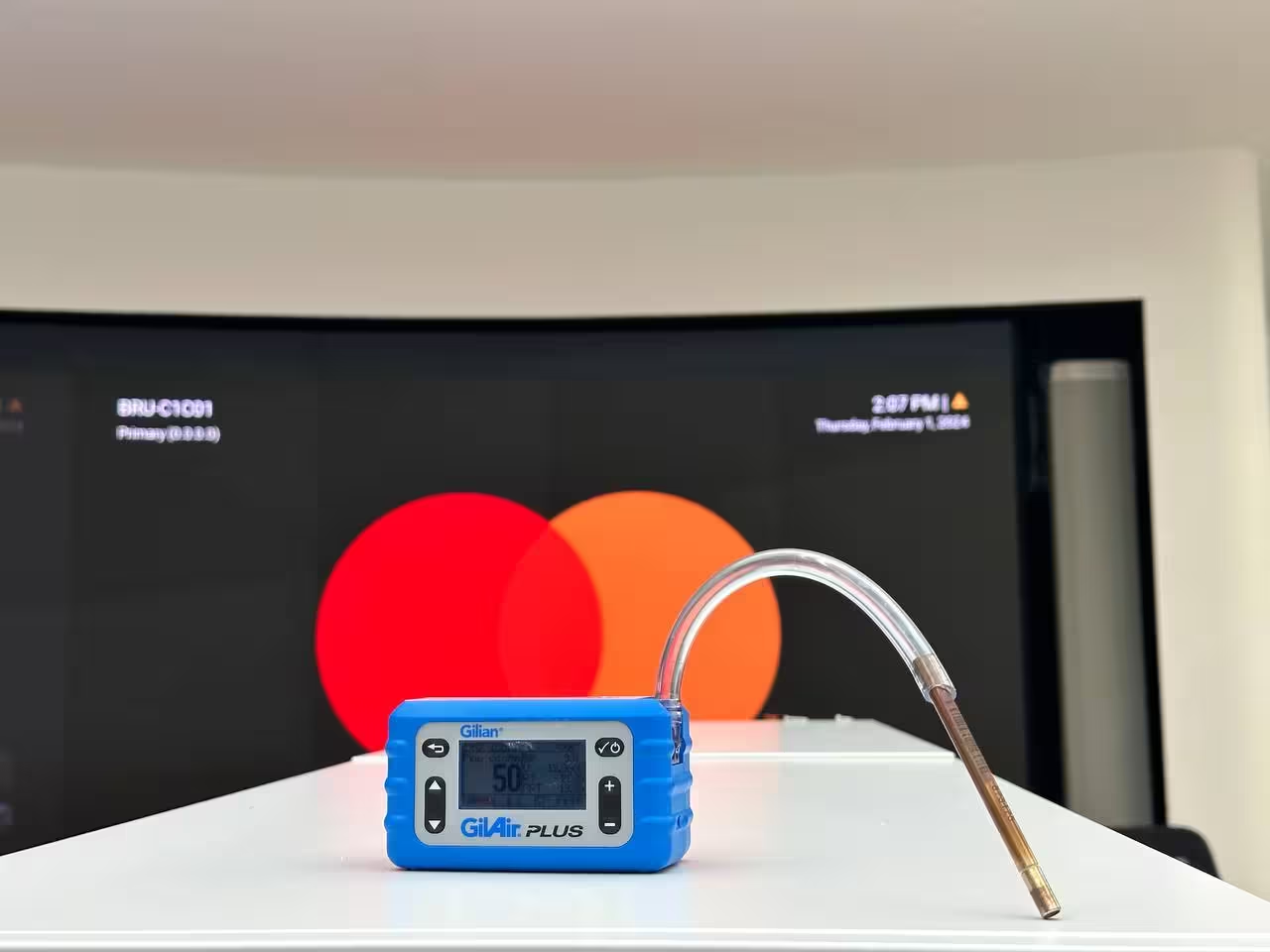
All measurements are conducted using calibrated, professional-grade instrumentation appropriate to the parameter and environment being assessed. Equipment performance and calibration status are documented as part of the assessment record.
Findings are interpreted against external reference conditions and site context rather than in isolation. This allows internal performance to be distinguished from broader ambient influences.
Airscan maintains a clear separation between assessment and remediation. Findings are reported without commercial dependency on downstream works or product sales.
Discuss your space, concerns, and find out what an IAQ Performance Audit would look like in practice for your indoor environment.