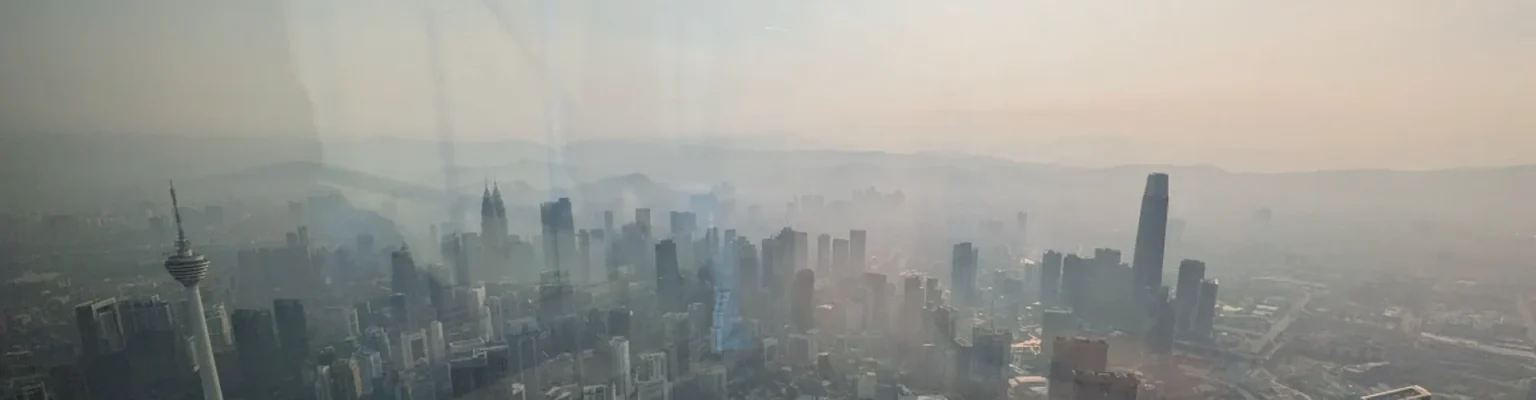
Europe’s air has been getting cleaner for thirty years. Emissions of gases that make ground-level ozone, nitrogen oxides from traffic, and volatile organic compounds from fuels and solvents, have fallen steadily since the 1990s, and the worst ozone peaks have fallen with them. On paper, 2026 should have been an easy summer for air quality.
It broke records instead. Belgium just had its hottest summer ever. France had its hottest summer since measurements began in 1900. During the June heatwave, a Global Witness report estimated around two in three people in the EU may have been exposed to harmful levels of ground-level ozone. Wildfires burned around 660,000 hectares across the EU, well above the long-term average – France set a national record, Belgium had its worst fire in a century – filling the air with fine particles that travelled hundreds of kilometers from the flames.
That’s the puzzle this summer leaves us with. Heat does two things to the air: it cooks up more ozone, and it dries the land until it burns, pushing out smoke. 30 years of emissions cuts lowered the worst ozone peaks, yet the heat that drives both keeps climbing. Heatwaves, it turns out, are doing more to the air we breathe than the long-term trends suggest.
The summer in numbers
Two numbers sit next to each other and look like a contradiction. The Paris region logged 16 days of ozone pollution over the summer – its worst run since 2003 – and yet the peaks themselves were lower than in decades past: 240 µg/m³ at the highest in 2026, against 282 in 2003, and over 300 in the 1990s, according to Airparif. Both are true. More days over the line, lower heights on the worst of them.
The peaks came down because policy worked. Stricter vehicle standards, controls on industry, and limits on VOCs in paints and solvents cut the emissions that feed ozone. Ozone is the pollutant Europe has made the least headway on. Local sources have fallen, but the background ozone drifting in from elsewhere has held flat or crept up, so cutting at home only gets you so far. The number of bad ozone days is climbing for a separate reason: heat drives ozone formation, and heatwaves are getting longer and more frequent.
Belgium learned this in 2003, when record heat, an ozone spike, and a sharp rise in deaths prompted a national “Heat and Ozone Peaks” plan. It runs every year from 15 May to 30 September across three phases: vigilance, warning and alert. In 2026 the warning phase was triggered through each of the of the summer’s 3 heatwaves.
Heat brought fire as well as ozone. According to IRCELINE, the monitoring station in Vielsalm – a town well away from the flames – recorded a PM2.5 peak of around 670 µg/m³ in August more than 8 times the level at which air quality is rated “very bad”. Airscan’s own network of sensors picked up spikes in PM2.5 from units up to 110km away.
Smoke does not stay local.
How heat fouls the air
Ground-level ozone is not emitted by anything directly. It forms in the air when sunlight hits other pollutants, mainly nitrogen oxides from traffic and combustion, and VOCs from fuels, solvents and vegetation. (This is the ozone you breathe at street level. The ozone layer that shields us from UV sits miles up and is a separate thing entirely.)
Heatwaves create ideal conditions for ozone. The high-pressure systems that bring the heat also bring weak winds and still air, so pollutants pool near the ground instead of dispersing. Strong sunlight drives the reaction all day, and ozone concentrations usually peak in the afternoon.
The heat also does something else. It dries out the land and sparks the right condition for wildfires, which throw out large amounts of PM2.5, tiny particles under 2.5 micrometres small enough to reach deep into the lungs and partly cross into the blood. Our Malaysian colleague, Ts. Syida Nazri, explored the effects of PM2.5 in her latest article about the health effects of the Indonesian fires drifting across Southeast Asia.
The cost to the body
Heat and air pollution are each dangerous alone, and together they form something worse. A Sciensano study found that June’s deaths tracked 3 things at once: how long the heat lasted, how hot it got, and the ozone in the air. It was the worst excess mortality they have recorded since their monitoring began in 2000.
The mechanism is simple enough. In hot weather the body works harder to shed heat, which strains the heart and circulation. At the same time ozone inflames the airways, bringing coughing, reduced lung function and asthma attacks, while fine particles aggravate existing heart and lung disease. The people with the least margin take the most damage: older adults, young children, pregnant women, people with chronic conditions, and anyone working outdoors.
The loop that feeds itself
According to Météo-France, a summer like 2026 would have been close to impossible without human-caused climate change. The opposite holds too, and that creates a loop. Ozone is itself a greenhouse gas and has added roughly 0.23°C to global warming. Black carbon, the soot in wildfire and combustion smoke, warms the air by absorbing sunlight.
So ’tis the cycle. Warming intensifies heatwaves, heatwaves worsen ozone and particle pollution, and those same pollutants push warming further along.
With that knowledge comes leverage: cutting ozone and black carbon buys back cleaner air and slower warming at once.
The levers cities hold
Cities hold the biggest levers: cleaner transport, lower emissions, and green space to take the edge off urban heat. Planting is not a guaranteed fix. Whether vegetation clears pollution or traps it depends on how streets are laid out and how air moves through them, which is exactly why measurement matters. Monitoring shows where pollution actually concentrates and whether a given measure is working or just looks good on paper.
For individuals during a pollution episode, the basics hold: follow local air quality alerts, skip hard outdoor exercise when ozone peaks in the afternoon, and stay hydrated through the heat.
The case for measurement
Summer 2026 revealed the pattern. Cleaner air across the year no longer guarantees clean air through a heatwave, because heat has become a pollution driver in its own right. As heatwaves get more frequent, tracking temperature and pollution together is how cities see what they are facing and respond in time.
At Airscan, we help cities, organisations and communities understand the air they breathe, indoors and out. By measuring pollutants like ozone and fine particles over time, we catch pollution episodes, map local exposure, and tell whether the measures meant to clean the air are earning their keep. Through projects like Villes pures and the Clean Air Alliance, we support that monitoring and help communities act on what it shows.