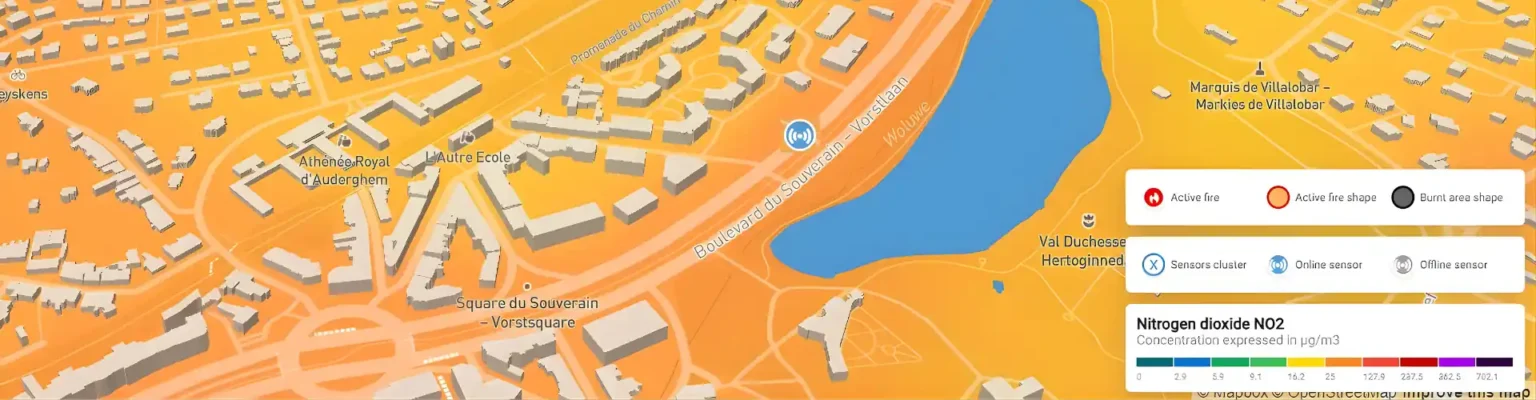
In November 2022, Belgium’s air quality monitoring scheme—the Belgian Air Quality Index (BelAQI)—underwent a major revision to better reflect the health risks associated with air pollution. Managed by IRCEL – CELINE, the updated index now aligns with the World Health Organization’s 2021 air quality guidelines, introducing stricter thresholds and faster reporting.
Key improvements
Alignment with WHO 2021 guidelines
BelAQI now uses the WHO’s latest limit values and interim targets. When annual limits are exceeded, the index reaches at least level 3 (“Good”); when daily limits are breached, it reaches at least level 6 (“Poor”). This closer alignment makes the index more directly relevant to health outcomes. The latest WHO guidelines can be found on the WHO website.
Faster detection with hourly averages
The revised system moves away from 24-hour averages and instead relies on hourly concentrations. This allows for faster detection of pollution peaks and enables more timely public alerts.
Stricter thresholds for key pollutants
While the familiar 1–10 scale is retained, the classification thresholds have been tightened. For example, a PM₂.₅ daily mean above 50 µg/m³ now corresponds to index level 10 (“Horrible”).
Clearer link to health impacts
Scientific evidence shows that at index level 8, the risk of daily mortality increases by around 2% for PM₂.₅ and NO₂, and by up to 4% for O₃. This strengthens the connection between air quality information and public health protection.
A step forward for public health
With these updates, Belgium’s air quality index now delivers more immediate and scientifically grounded information to both the public and authorities. By aligning with WHO standards and improving real-time reporting, the revised BelAQI supports better awareness of air pollution and contributes to reducing pollution-related health risks.
For more information, visit the Belgian Interregional Environment Agency (IRCEL – CELINE).